By the end of this post, you’ll know how to match your dose to your basket, recognize when a basket is fighting you rather than helping you, and decide whether swapping baskets is worth doing for your setup. Basket size is one of those variables that quietly shapes every shot you pull, yet it rarely gets explained clearly, so let’s go through the questions that actually matter.
What does “basket size” even refer to?
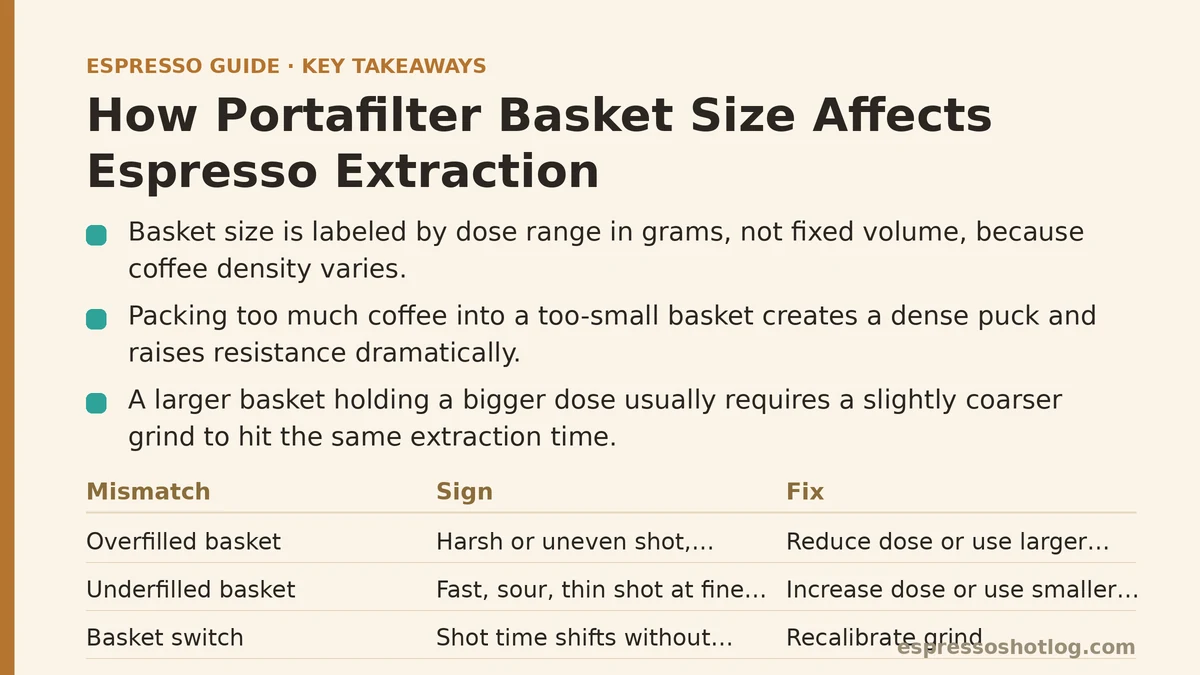
Baskets are usually labeled by the dose range they’re designed to hold — something like 14-18 grams for a “double” basket, or 18-22 grams for larger ridgeless baskets that have become common on newer machines. The number refers to grams of ground coffee, not a fixed volume measurement, since coffee density varies slightly from bean to bean.
The basket’s actual dimensions — diameter and depth — are what determine that range. A wider or deeper basket holds more coffee before the puck gets packed too tightly for water to pass through evenly, while a smaller basket runs out of usable depth much sooner.
Why does dose range matter so much for extraction?
Because the coffee bed’s depth and density directly control how water moves through it. Pack too much coffee into a basket that’s too small for the dose, and you create a densely compressed puck with very little headspace, which raises resistance dramatically and often produces water channeling through cracks rather than moving through the grounds evenly.
Underfill a basket that’s meant for a larger dose, and you get the opposite problem: a shallow, loosely packed bed that lets water rush through with minimal resistance, pulling a thin, weak shot no matter how fine you grind.
Either mismatch fights against you before you’ve touched the grinder dial.
How do I know if my basket and dose don’t match?
A few signs tend to show up together. If you’re consistently forced into an extremely fine grind just to hit a normal shot time, and the shot still tastes harsh or unevenly extracted, an overfilled basket is a likely explanation. If your shots run fast even at a fine grind setting and taste sour or thin despite your best dial-in effort, an underfilled basket is worth suspecting instead.
The simplest check is visual: pull the portafilter after tamping and look at how close the compressed puck sits to the basket’s rim. A puck that’s nearly overflowing, with almost no clearance under the shower screen, signals overfilling. A puck sitting well below where the basket’s ridge or wall would normally guide it suggests you’re under the intended range.
Does basket size change what grind setting I should use?
Yes, and this is where a lot of people get stuck troubleshooting the wrong variable. A larger basket holding a bigger dose naturally creates more resistance at a given grind size, simply because there’s more coffee for water to travel through. That usually means you’ll land on a slightly coarser grind than you would with a smaller basket and a lighter dose, in order to hit the same extraction time.
Switch baskets without adjusting your grind, and your timing will shift even though nothing else about your technique changed. This is a common source of confusion when people upgrade to a larger basket expecting identical settings to carry over — they don’t, not exactly, and a short recalibration period is normal.
Are larger baskets more forgiving, or less?
Generally more forgiving, within reason. A larger basket at a moderate dose gives you a deeper coffee bed with more room for water to distribute evenly, which tends to smooth over minor inconsistencies in tamping pressure or distribution technique. Smaller baskets, with their shallower beds, leave less margin for error — small unevenness in your puck prep shows up more directly in the cup.
That said, forgiving isn’t the same as ideal. A larger basket still needs a dose that suits it. Push a big basket to its upper limit or beyond, and it becomes just as unforgiving as a small one that’s overfilled, since you’ve recreated the same overly dense, low-headspace problem in a bigger container.
Should I switch to a different basket size?
That depends on what you’re chasing. If you keep fighting an oddly fine grind requirement, or your shots taste unbalanced despite careful technique, and you’ve confirmed your current dose sits at the very edge of your basket’s range, moving to a basket built for a slightly higher or lower dose can resolve the issue directly rather than asking your grinder to compensate for a structural mismatch.
If your shots already come out balanced and repeatable within your basket’s stated range, there’s little reason to change anything. Basket swaps solve a specific problem — dose and basket geometry working against each other — and they’re not a general-purpose upgrade that improves shots on their own.
Does basket shape matter as much as size?
It plays a real role, though a smaller one than dose range. Ridgeless baskets, which have largely replaced the older ridged style on quality equipment, tend to encourage more even water distribution across the puck by removing the internal lip that could otherwise create weak points near the basket wall. Precision baskets, with more uniform hole sizing and spacing, aim to reduce channeling further still.
None of that replaces getting your dose right for the basket you’re using, but it does mean two baskets with identical labeled capacity can behave a little differently in practice. Worth knowing if you’re comparing options rather than assuming size is the only spec that counts.
What’s the simplest way to get this right without overthinking it?
Start with the dose range printed or listed for your specific basket, weigh your coffee to land comfortably within that range rather than at either extreme, and check your puck’s clearance under the shower screen after tamping. Adjust grind from there to hit your target shot time. If you find yourself needing a grind setting that feels unusually fine or unusually coarse compared to what similar recipes suggest, look at where your dose sits in the basket’s range before assuming something else is wrong.
Basket size isn’t the flashiest variable in espresso, but it sets the boundaries everything else has to work within — which is exactly why it’s worth getting right before chasing fixes elsewhere.
Related guides: What Is Preinfusion and Why It Matters for Espresso, Decaf Espresso Guide: Flavor and Extraction Tips, and Espresso Extraction Time: Too Fast or Too Slow Fix.