Altitude changes the boiling point of water and the atmospheric pressure your machine’s pump has to work against; humidity changes how much moisture your beans hold before they ever hit the grinder. Both factors alter extraction, but through completely separate mechanisms — which means a fix that addresses one will do nothing for the other, and confusing them leads to a lot of wasted dial-in time.
This matters more than most brewing guides let on, because most dialing-in advice assumes a fairly generic set of conditions: sea level, moderate humidity, a stable environment. Live somewhere that doesn’t match that description — a mountain town, a humid coastal city, a place with real seasonal swings — and the standard advice stops being reliable on its own.
Beginner Level: What You Need to Know First
Altitude, in Simple Terms
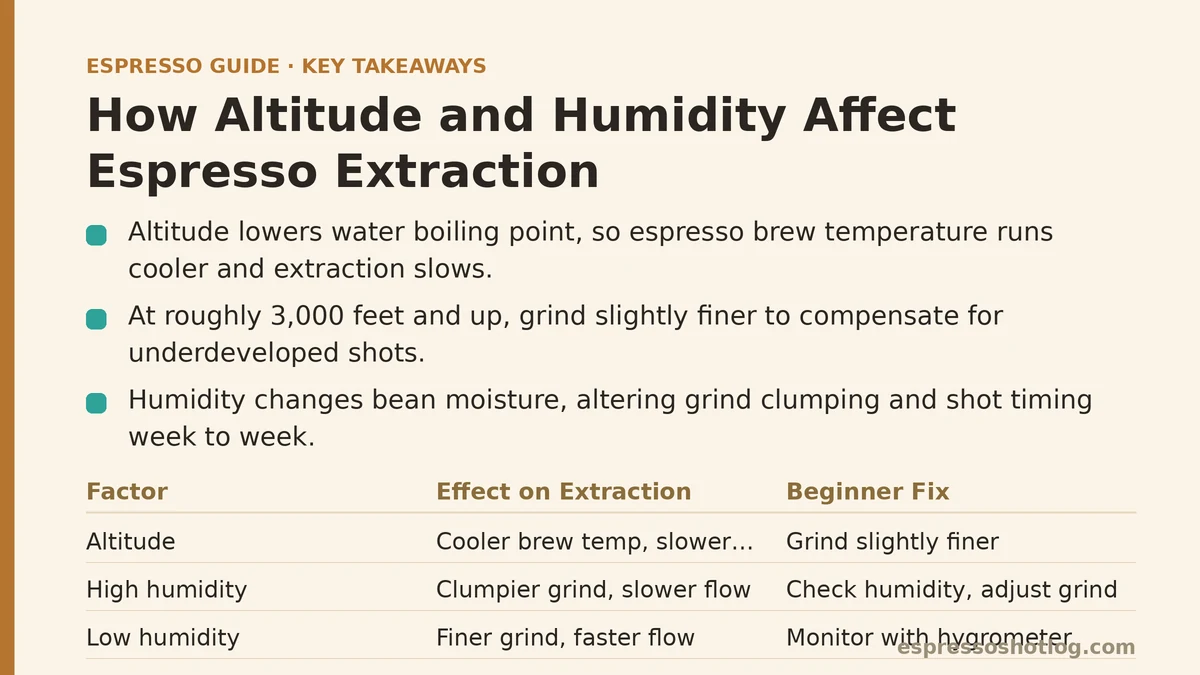
Water boils at a lower temperature as altitude increases. At sea level it’s 212°F (100°C); by the time you’re up around 5,000 feet, that drops closer to 203°F (95°C). Espresso machines don’t boil water outright, but this same pressure-driven relationship still shifts the temperature your machine produces at a given internal pressure setting, which means your effective brew temperature at altitude tends to run a touch cooler than the same machine would deliver near sea level.
Cooler effective brew temperature slows extraction. A shot dialed in at sea level, moved to a mountain town and pulled with identical grind, dose, and timing, will often taste flatter and less developed — not because anything is wrong with the beans or the machine, but because the water simply isn’t extracting as much at that temperature.
The beginner fix: If you’re at meaningful elevation — roughly 3,000 feet and up — and your shots taste underdeveloped despite normal timing, grind slightly finer than you would at sea level. That compensates for the cooler effective temperature by increasing resistance and extending contact time, without you needing to touch anything on the machine itself.
Humidity, in Simple Terms
Coffee beans are porous and hygroscopic, meaning they absorb moisture from the surrounding air. In a humid environment, beans pick up ambient moisture even in a sealed bag between openings, and that added moisture changes how they grind and how water moves through the resulting grounds.
Humid beans tend to grind slightly clumpier and can pack more densely in the basket, which slows water flow and pushes extraction time longer than your grind setting alone would suggest. Dry, low-humidity air has close to the opposite effect — beans grind finer and flow faster than expected for a given setting.
The beginner fix: If your shot timing keeps drifting from week to week despite no change in grind setting or bean, check your local humidity before assuming the beans or machine are the problem. A basic hygrometer near your grinder gives you a fast, cheap way to confirm what’s actually shifting.
Advanced Level: Deeper Mechanisms and Fine-Tuning
The Pressure-Temperature Relationship at Altitude
Boiling point isn’t the only altitude effect worth understanding — atmospheric pressure itself is lower, and that changes the pressure differential your pump has to overcome to reach its target nine bars. Most consumer machines compensate automatically well enough that this differential rarely causes a mechanical problem, but the lower ambient pressure does subtly affect how quickly steam pressure builds in the boiler, which can shift pre-infusion behavior on machines that rely on boiler pressure for that stage.
Practically, this means two identical machines at different elevations, running the same nominal settings, can produce measurably different pre-infusion timing and slightly different peak pressure curves — a variable most home baristas never think to check because it doesn’t show up anywhere on the machine’s display.
The advanced adjustment: If you have access to a PID-controlled machine, raising your brew temperature setpoint by one to two degrees Fahrenheit at higher elevations often restores the extraction development that a stock temperature setting would otherwise lose to the altitude effect. Pair that with a marginally finer grind, and you’ll typically land back in the same flavor territory you’d get at sea level with your original settings.
Bean Density Changes from High-Altitude Growing Regions
There’s a second, less obvious altitude effect worth knowing: beans themselves grown at high elevation — many specialty Central and South American lots, for instance — tend to be denser than lowland-grown beans, a product of the slower maturation that cooler mountain growing conditions produce. Denser beans resist grinding differently and often require a finer setting to hit the same extraction time as a softer, lowland bean.
This is a separate issue from brewing at altitude, but the two frequently get tangled together, since high-altitude-grown beans are also often the ones being brewed by people who happen to live at elevation. Worth untangling the two: one is about where the coffee was grown, the other about where you’re standing when you pull the shot.
Humidity’s Effect on Grind Consistency Over Time
Advanced troubleshooting on the humidity side means paying attention to consistency, not just average conditions. A bag of beans opened on a dry winter day and finished three weeks later during a humid spell won’t grind the same way at the end as it did at the start, even though nothing about your grinder setting changed. This shows up as a slow drift in shot timing across the life of a single bag — something a lot of home baristas mistake for grinder burr wear or bean staling.
The advanced adjustment: Track your grind setting and shot timing together over the life of a bag, not just at the point of dial-in. If timing drifts gradually in one direction as the weeks pass, check whether local humidity has shifted over the same window before assuming your equipment or beans are declining. A small, incremental grind adjustment partway through a bag’s life is a normal, expected correction in a variable-humidity climate — not a sign that something’s broken.
Combining Both Variables: A Real-World Example
Picture pulling espresso in a humid mountain town at 6,000 feet — a combination that isn’t rare, and it’s genuinely tricky because the two variables push in different directions on different parts of your extraction. Altitude pushes you toward a finer grind and possibly a higher temperature setpoint to compensate for cooler effective brewing conditions. Humidity, meanwhile, may already be adding resistance to your grind independent of the setting itself, meaning you could easily over-correct if you dial in for altitude without separately accounting for what humidity is doing to your beans that week.
The way through this is sequential, not simultaneous: adjust for one variable, taste and time the result, then adjust for the other rather than changing grind and temperature together and guessing at which factor caused which part of the change.
Quick Reference: Beginner vs. Advanced Adjustments
| Situation | Beginner Fix | Advanced Fix |
|---|---|---|
| High altitude, underdeveloped shots | Grind slightly finer | Raise brew temp 1–2°F via PID, then fine-tune grind |
| High humidity, slow/clumpy grind | Check timing against a hygrometer reading | Track grind-timing drift across a bag’s full lifespan |
| Dense, high-altitude-grown beans | Expect a finer setting than usual | Separate growing-altitude effects from brewing-altitude effects explicitly |
| Both factors present at once | Adjust grind, taste, repeat | Adjust one variable at a time, in sequence, not together |
Altitude and humidity aren’t problems to solve once and forget — they’re ongoing environmental variables that deserve the same periodic attention you’d give to bean freshness or machine cleaning. Once you know which mechanism is behind a shift in your shots, the fix is usually a small, specific adjustment rather than a full re-dial from scratch.
Related guides: Espresso Extraction Time: Too Fast or Too Slow Fix, Why Your Espresso Is Bitter and How to Fix It, and Why Your Espresso Tastes Sour and How to Fix It.