You will be able to tell anyone why a shot of espresso and a glass of cold brew are different in nearly every way that matters, and you will know which one to reach for depending on your morning, your mood, and your stomach. These two coffees share a reputation for intensity — but the resemblance mostly ends there.
Is cold brew just espresso served over ice?
This is the question I hear most from people who are new to both. The answer is no, and the difference starts before either one touches a cup.
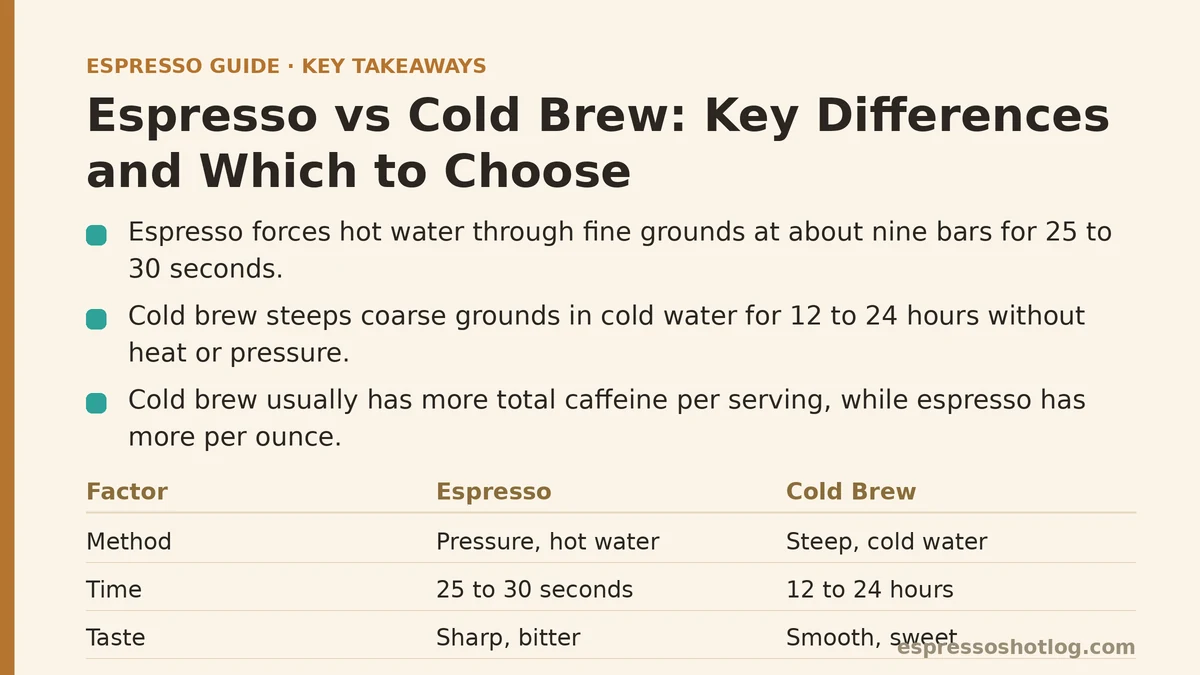
Espresso is hot water forced through finely ground coffee at around nine bars of pressure. The whole process takes 25 to 30 seconds. The grind is fine as powdered sugar, the water is just off the boil, and the result is a small, concentrated shot with a layer of crema on top.
Cold brew is made by steeping coarse coffee grounds in cold or room-temperature water for 12 to 24 hours. No pressure, no heat, no equipment beyond a container and a filter. The grind looks more like sea salt or rough sand. The extraction is slow, gentle, and entirely chemical — time does what pressure does for espresso, just at a different speed and temperature.
So no, they are not the same drink serving different temperatures. They are as different as a pressure-cooked stew and a slow-marinated salad. Both taste like coffee, but the process shapes everything else about them.
Why does espresso taste sharp while cold brew tastes smooth?
The sharpness in espresso comes from acidity and bitterness developing during a hot, fast extraction. Heat pulls out flavor compounds quickly, including the bright, tangy acids that hit the sides of your tongue right after a shot, and the bitter compounds that linger on the back of your palate. That combination of sharp and bitter is what gives espresso its intensity.
Cold brew barely develops either of those. Cold water extracts flavor more selectively — it pulls the sweeter, chocolatey, nutty compounds while leaving many of the harsh acids and bitter elements behind. That is why cold brew tastes smooth, almost syrupy, with a roundness that coats your mouth instead of snapping at it.
One of my regulars describes the difference as espresso being a handshake and cold brew being a hug. I think that is about right. Espresso demands your attention; cold brew slides down without asking for it.
Which one has more caffeine, espresso or cold brew?
This comes up constantly, and the honest answer is that it depends on what you mean by “more.”
Per ounce, espresso wins easily. A single shot has roughly 63 milligrams of caffeine in just 1 to 2 ounces. Cold brew concentrate, depending on how strong you brew it, might have 100 to 200 milligrams per 8-ounce serving — but that serving is four times the volume of a shot.
If you are comparing a single shot against an 8-ounce glass of cold brew, the cold brew typically has more total caffeine. If you are comparing equal volumes — a 2-ounce shot versus 2 ounces of cold brew — espresso dominates.
For most people, the practical question is about the whole drink, not the ounce. A cold brew concentrate mixed with water or milk at a 1:1 ratio will usually deliver 150 to 200 milligrams per 12-ounce glass. A double shot of espresso has about 126 milligrams. So if you want maximum caffeine per serving, cold brew is the better bet. If you want a quick, strong hit, espresso does the job with a smaller footprint.
Does cold brew really have less acid?
Yes, and this is one of the most measurable differences between the two. Cold extraction produces coffee with significantly lower titratable acidity than hot brewing methods. In informal taste tests and in the experience of customers who have sensitive stomachs, cold brew is often reported as the easier option to digest.
There are two reasons for this. First, the cold water slows down the extraction of organic acids, so fewer of them end up in your cup. Second, the longer steep time allows some of the extracted acids to break down or bind into less reactive forms. The result is coffee that does not trigger heartburn the way a bright, acidic espresso or pour-over can.
That said, none of this is a guarantee. If you have severe acid reflux, cold brew is still coffee, and coffee is still mildly acidic. But customers who switch from espresso to cold brew sometimes report noticeably less discomfort within a week. It is worth trying if your stomach has been complaining about your morning routine.
Can I make cold brew with my espresso machine?
You can, but not in the way you might hope. Your espresso machine cannot make cold brew — the pressure and heat are the wrong tools for that job. What you can do is use your espresso grinder to grind coarse enough for cold brew, then brew it in a separate container using cold water.
The workflow looks like this: grind 50 grams of coffee at a coarse setting, combine with 400 grams of cold water in a large jar or French press, stir to saturate, cover, and leave it in the fridge or at room temperature for 12 to 18 hours. After steeping, filter out the grounds with a fine mesh strainer or a paper filter. You will have a concentrate that you can dilute with water or milk.
The catch is that switching between espresso-grind and cold-brew-grind on your grinder takes time, and going back to espresso requires a full cleanup to remove the coarse grounds. If you only make cold brew occasionally, this works fine. If you want it regularly, a separate inexpensive burr grinder for cold brew saves a lot of fiddling.
When should I choose espresso instead of cold brew?
Espresso wins when you want intensity, speed, and that rich, syrupy texture. It is the right choice when you have a few minutes to enjoy something small and deliberate — a shot pulled and finished in two minutes, or a cappuccino that pairs with a moment of quiet before the day gets loud.
Espresso also wins when the weather is cold. A hot shot on a winter morning does something that cold brew cannot touch, regardless of how smooth the latter is. If you want to feel the warmth spreading through your chest as you drink, espresso is the answer.
And if you are building milk drinks — lattes, flat whites, cortados — espresso is non-negotiable. Cold brew with milk is fine, but it lacks the crema and the concentrated flavor that hold up against steamed milk. You cannot foam cold brew. You cannot pull a ristretto shot from a jar of steeped grounds.
When should I choose cold brew instead of espresso?
Cold brew shines in the summer and in the afternoon. A tall glass of cold brew with ice is practically designed for a hot day when a hot shot sounds oppressive. It also handles long sipping sessions better — the lower acidity and smoother flavor mean it stays pleasant for an hour or more, whereas an espresso shot is best finished immediately.
Cold brew is also forgiving. It is nearly impossible to ruin. As long as you use a coarse grind and reasonable steeping time, you will get something drinkable. Espresso punishes uneven grinds, wrong temperatures, and sloppy tamping. Cold brew asks only that you wait.
I also point people toward cold brew when they tell me they are struggling with the intensity of espresso. If espresso feels harsh on your tongue or your stomach, cold brew gives you the caffeine and the coffee flavor without the bite. It is a gentler entry point.
How do I decide when both sound good?
Choose based on your hour.
If it is before noon, you want something hot, and you will finish the drink within five minutes — espresso. If it is after two in the afternoon, it is warm outside, and you want to nurse a drink while working or reading — cold brew.
If you want flavor intensity and complexity, espresso. If you want smoothness and caffeine volume, cold brew.
And if you are torn, order a double shot and make a small glass of cold brew at home. Keep both in your rotation. There is no rule that says you have to pick one and stick with it.
A quick comparison table for when you are in a hurry
| Factor | Espresso | Cold Brew |
|---|---|---|
| Brew time | 25–30 seconds | 12–24 hours |
| Water temperature | Near boiling | Cold or room temp |
| Grind size | Fine, like powdered sugar | Coarse, like sea salt |
| Equipment | Espresso machine required | Jar, filter, and patience |
| Acidity | High | Low |
| Caffeine per ounce | High | Medium |
| Caffeine per serving | Low (single shot) | Higher (typical 8–12 oz glass) |
| Body and mouthfeel | Syrupy, thick, crema on top | Smooth, silky, no crema |
| Serving temperature | Hot | Cold or over ice |
| Milk drink compatibility | Excellent | Limited |
| Difficulty level | Finicky, hard to master | Nearly foolproof |
The one question to ask yourself before choosing
Sit with this: are you looking for a moment or a marathon?
Espresso is a moment — intense, fleeting, requiring your full attention. Cold brew is a marathon — steady, smooth, made for slow consumption. Neither is better. They just answer different needs.
A customer might pull two shots every morning and brew a jar of cold brew every Sunday. She uses espresso to wake up and cold brew to get through the afternoon. I think she has the right idea.
So try both. Give each a fair chance. Then let your morning tell you which one it is asking for.
Related guides: Espresso Tamping Technique: Step-by-Step Guide for Beginners, Espresso Troubleshooting Flowchart: Diagnosing Shots by Taste and Time, and How to Pull Espresso Shots on a Manual Lever Machine: A Beginner’s Step-by-Step Tutorial.