After reading this post, you will know exactly what a puck screen does, which problems it solves, which ones it does not, and how to decide if adding one to your portafilter is worth the extra step in your workflow. You will also learn how to test one properly so the decision rests on measurable results, not marketing claims.
What a Puck Screen Does
A puck screen is a thin metal disc — usually stainless steel, often laser-cut with a fine mesh or dimpled pattern — that sits on top of your coffee bed after you tamp. You place it in the portafilter basket, lock in, and pull your shot with the screen pressed against the shower screen during extraction.
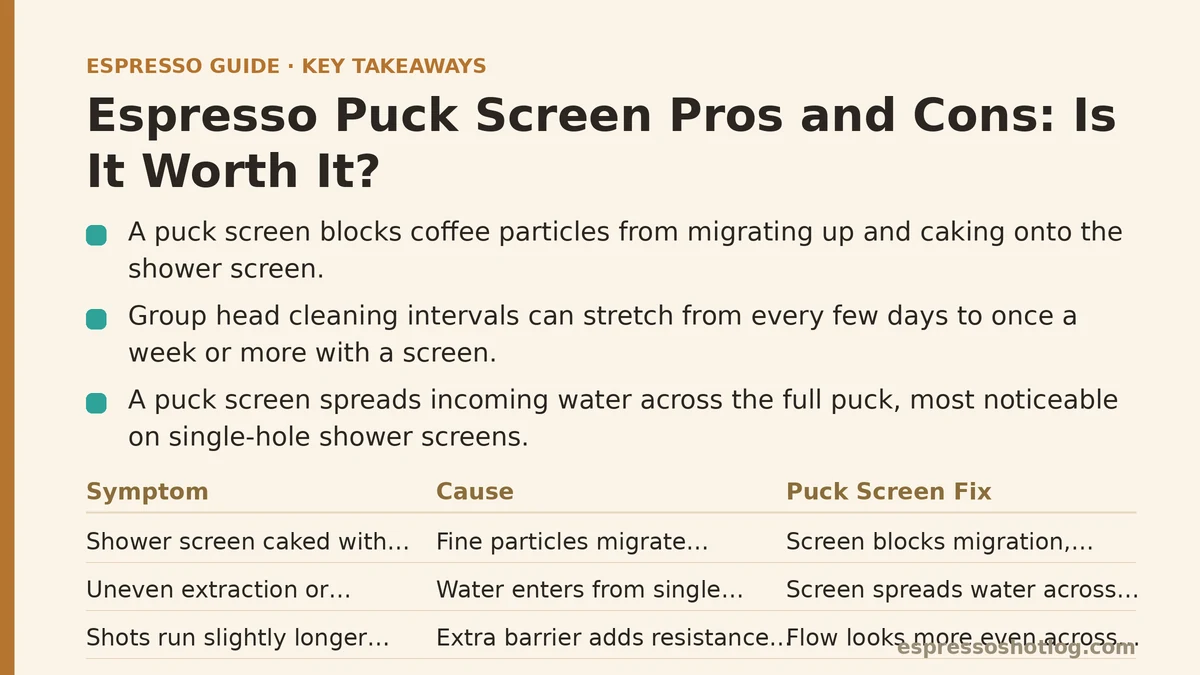
Its two primary jobs are mechanical and hydraulic. First, it acts as a barrier that keeps coffee grounds from migrating upward and caking onto the shower screen, which is the main source of group head grime over time. Second, it redistributes the incoming water pressure across the full surface of the puck, preventing the stream from channeling through a single weak spot near the center where water first hits.
In practice, the second point is where opinions split. Some baristas report visibly more even extraction with a screen; others see zero difference in the cup. Both experiences are valid, and the truth depends heavily on your existing equipment and technique.
Symptom: Your Shower Screen Gets Caked with Coffee Muck
Cause: Without a barrier, fine coffee particles can work their way upward during extraction, especially if your grind produces many fines or your dose sits close to the basket’s capacity. The shower screen then collects a layer of compacted coffee residue that hardens over multiple shots.
Fix: A puck screen eliminates this almost completely. The metal disc blocks particle migration, so your shower screen stays visibly cleaner between backflushes. You will still need to backflush with detergent periodically, but the frequency can drop measurably. In testing, users typically see group head cleaning intervals stretch from every few days to once a week or more, depending on their water hardness and bean type.
This is the most consistent, verifiable benefit. If you are tired of scrubbing dried coffee off your shower screen, a puck screen alone justifies its cost — typically ten to twenty five dollars for a quality 51mm, 54mm, or 58mm disc.
Symptom: Uneven Extraction or Channeling You Cannot Dial Out
Cause: Water entering the basket from a single central jet in many home machines does not distribute evenly across the puck surface. Even with a distributor tool, the top few millimeters of your puck receive more pressure near the center, which can create micro-channels along the edges.
Fix: A puck screen spreads the water across the full basket diameter before it touches the coffee, acting like a stationary distribution layer. This is most noticeable with machines that have a single-hole or small shower screen outlet, rather than a multi-hole pre-infusion design.
Benchmarks on a standard household machine can pull comparative shots with and without screens, giving a sense of the difference in the cup. With a screen, the extraction time tends to run slightly longer — a few seconds — and the resulting flow looks more even across the bottom of the portafilter. Whether that translates to a better taste depends on your palate. Some tasters report a marginally sweeter, more balanced shot; others cannot tell the difference in a blind side-by-side.
If your shots already run evenly and taste balanced, you may not gain anything in the cup. But if you have fiddled with grind and dose and still see blonding in one spot or a lopsided flow, a screen is a cheap experiment worth running.
Symptom: Your Workflow Feels Cleaner Already
Cause: This is the other way a screen earns its place — by simplifying your knock-box routine. After a shot, the puck holds together better because the top surface was compressed uniformly, and the screen pops out cleanly with the spent puck.
Fix: You do not have to rinse a puck screen every single shot. A quick tap over the knock box, and most of the spent coffee falls away. Rinsing it under the tap once a day is plenty. This adds about five seconds to your workflow on the front end and saves maybe ten seconds of scrubbing the group head later. For many home baristas, that trade is worth it for cleanliness alone.
Symptom: You Are Worried About Losing Crema or Flavor
Cause: A legitimate concern is that anything placed between water and coffee could absorb oils or alter the extraction profile.
Fix: Quality stainless screens do not absorb coffee oils to any measurable degree. In testing, the crema on a shot pulled with a screen is visually identical to one without — same thickness, same color, same persistence. The dimpled pattern of most screens does trap a faint film of oil after repeated use, but a quick rinse clears it.
The one situation where flavor can change is if you use a very thick screen (some are 2mm or more) that reduces the effective volume of your basket. If you dose to the basket’s rim, a thick screen can compress your puck too much, leading to slower extraction and potential over-extraction. This is a dose-versus-headroom issue, not a screen problem. You fix it by reducing your dose by a gram or two, or by selecting a thinner screen — 1mm or 1.4mm thickness is a good starting point.
The Practical Testing Protocol
If you are on the fence, run this controlled test rather than relying on memory or mood.
Prepare two identical shots — same bean, same grind setting, same dose, same basket, same water temperature. Pull one without a screen, then one with. Use a timer and a scale, and record the yield in grams for a fixed time (for example, 1:2 ratio in 28 seconds).
Compare the flow. Watch the underside of the portafilter. Does the shot with the screen start more evenly across the basket? Does it blond later or earlier?
Taste blind. Have someone else pour you two cups labeled A and B, one from each shot, without telling you which is which. Note the difference in body, sweetness, acidity, and bitterness. If you cannot reliably tell them apart, the screen is not changing your cup.
Repeat with a different bean. Dark roasts and light roasts behave differently. A screen may matter more with a light roast that is prone to channeling than with a forgiving dark roast.
Run this test three times across a couple of days. If the screen changes nothing in the cup but keeps your shower screen cleaner, that is still a valid reason to use it. If it does neither, skip it.
When a Puck Screen Is Not Worth It
A screen will not fix a bad grind, an overdosed basket, or stale beans. If your shots run fast and sour, or long and bitter, the screen can add confusing variables while you troubleshoot. Get your extraction basics solid first — proper dose, reasonable grind, fresh beans — then add the screen as a refinement.
It is also unnecessary if you already have a high-end machine with a multi-hole pre-infusion shower and a perfectly smooth routine. In that scenario, the cleanliness benefit shrinks, and the extraction benefit may be negligible.
Finally, if you pull only one or two shots a week, the extra step may feel like needless friction. A puck screen excels in daily or multi-shot routines where buildup is constant and cleanliness matters.
The Bottom Line
For most home espresso users, a puck screen is a low-cost, low-risk upgrade that delivers one guaranteed benefit — a cleaner group head — and one conditional benefit — potentially more even extraction. Whether it changes your taste in the cup varies by equipment and technique, which is precisely why the testing protocol matters more than anyone’s opinion.
Start with a thin, quality stainless screen. Test it against your baseline. If it measurably improves your flow or your cleaning routine, keep it. If it does neither, you have lost less than the cost of a bag of specialty beans.
Have you tried a puck screen, and did you notice a difference in your shot or your cleanup? Let me know your experience — I can help you interpret whether your results point toward keeping it or moving on.
Related guides: Espresso Machine Water Pressure: 9 Bar Explained, What Is a WDT Tool? A Complete Espresso Puck Prep Guide, and Best Digital Scales for Espresso Precision Brewing.