Say you are three years into owning a heat exchanger machine, and the steam wand has started sputtering. Or the pump sounds labored on startup, or water pools under the drip tray after every session. You open a parts site, see a $40 pump and a $180 control board listed next to each other, and the question lands hard: is this the beginning of a repair relationship, or the moment to start shopping again?
That decision is mostly arithmetic, but the arithmetic has more variables than people expect. Machine age matters, but so does the ratio of repair cost to replacement cost, the availability of parts, and whether the failure is a wear item or a symptom of something structural. The sequence below walks through how to frame the question, in the order you should think about it.
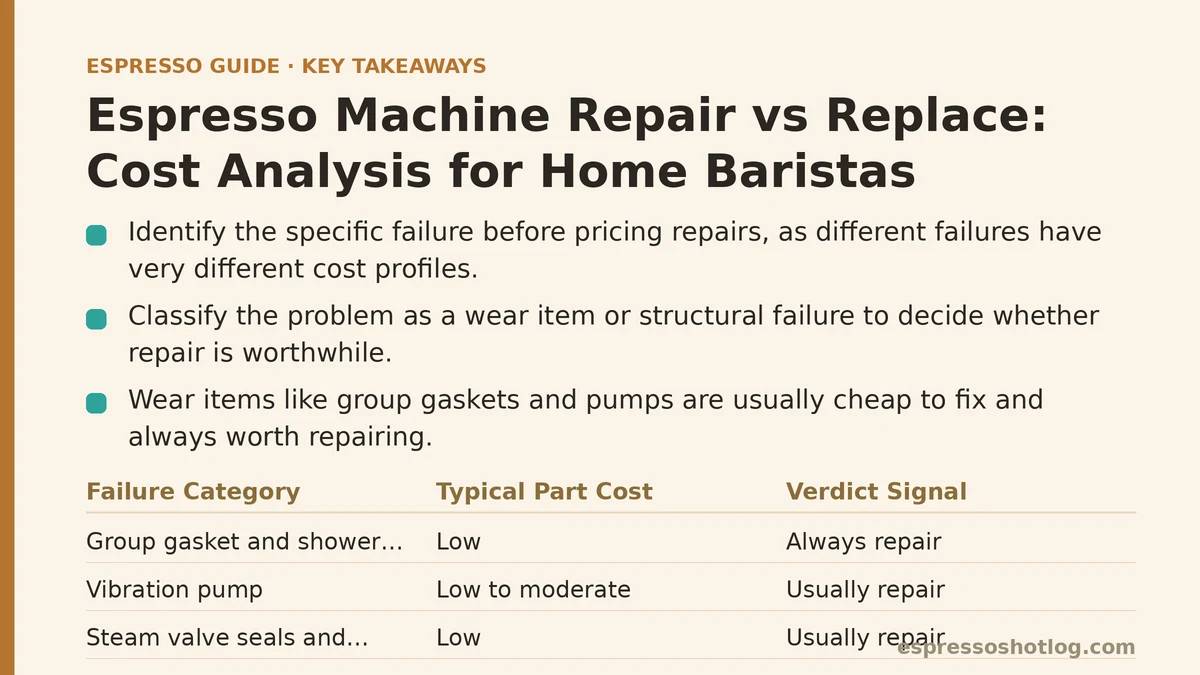
Step 1: Identify What Broke Before You Price Anything
Repair-versus-replace arguments go sideways when people compare a vague “it’s broken” against a new machine’s sticker price. Nail down the specific failure first. Most home espresso machines fail along a short list of predictable paths, and each one carries a very different cost profile.
- Pump failure. Descaling neglect, scale buildup, or simple wear on a vibration or rotary pump. Pumps are usually the cheapest major component to replace.
- Scale buildup and clogged hydraulics. Often masquerades as a weak pump. A machine that loses flow over months is frequently scaled, not broken. Descaling, a group head rebuild, or solenoid replacement may be the fix.
- Group head and gasket wear. A leaking portafilter, water escaping around the basket rim, or a shot that pulls differently each time often traces to a hardened group gasket and a worn shower screen. Low-cost, high-impact repair.
- Steam valve or wand leaks. Seals and O-rings degrade. On many machines these are inexpensive parts, though access can be fiddly.
- Heating element or boiler failure. The expensive end. A failed element can mean a boiler teardown, and on some machines the boiler and element are a single sealed unit.
- Electronics and control board faults. Hard to predict, often the priciest single part, and sometimes the point where replacement starts to make sense.
- Leaks from cracked boilers or fittings. Structural failures that can cascade into rust and board damage if left alone.
Listen for the pump’s pitch on startup, watch the flow rate of a blank shot, and inspect under the drip tray for standing water. A machine that hisses, drips, or takes noticeably longer to reach pressure is telling you which of these categories you are in.
Step 2: Separate Wear Items From Structural Failures
Before you price a repair, classify the failure. Wear items are consumables that fail on a schedule and carry predictable, low costs. Structural failures involve the frame, boiler, or electronics and can cost a significant fraction of a new machine.
| Failure Category | Typical Part Cost | Labor if Serviced | Verdict Signal |
|---|---|---|---|
| Group gasket and shower screen | Low | Low | Always repair |
| Vibration pump | Low to moderate | Low to moderate | Usually repair |
| Steam valve seals and O-rings | Low | Moderate | Usually repair |
| Solenoid valve | Low to moderate | Moderate | Usually repair |
| Scale-clogged boiler (descale or rebuild) | Moderate | Moderate to high | Repair if machine is otherwise sound |
| Heating element (replaceable) | Moderate | High | Borderline — compare to replacement |
| Control board / electronics | Moderate to high | Moderate | Borderline, especially on older machines |
| Cracked boiler or frame corrosion | High | High | Usually replace |
The pattern is straightforward: if the failure is a seal, a pump, or a valve, you are almost always better off repairing. If it involves the boiler or the electronics on a machine that is already several years old, the math gets tight. Frame corrosion or a cracked boiler is usually the end of the road, because repairing one failure rarely prevents the next one on the same compromised part.
Step 3: Run the Ratio, Not Just the Dollar Amount
The single most useful number is the repair cost expressed as a percentage of what a comparable new machine costs today. A common rule of thumb among equipment owners in many hobbyist categories: if the repair comes in under roughly a third of replacement cost, repair. Between a third and half, use judgment based on machine age and condition. Above half, replacement tends to win.
A worked example is clearer than the rule. Suppose your machine cost $800 new three years ago, and today’s equivalent model runs $900. A $120 pump replacement is about 13% of replacement cost — repair without much debate. A $400 control board replacement is about 44% — real deliberation territory. A $550 boiler and element repair is 61% — very likely time to shop.
The ratio does not exist in isolation, though. Two other inputs push the verdict:
- Remaining useful life. A well-maintained machine with a solid chassis and a healthy boiler can realistically serve many more years. A machine already showing multiple small failures is telling you its remaining life is short regardless of the current repair.
- Parts availability. A machine that is still in production and has a deep parts catalog is far more repairable than a discontinued model that requires hunting for secondhand components. A cheap machine with no parts support is functionally a throwaway.
Step 4: Check Whether the Repair Risks the Machine
This is the step beginners skip, and it is the one that saves the most frustration. A repair can fail to fix the problem, uncover a second problem, or damage something during the work. Before committing, ask what happens if the first fix does not resolve the symptom.
A weak pump replaced with a healthy one may reveal that the root cause was scale, and now your brand-new pump pushes water through a clogged boiler. A control board replaced on a machine with a slow leak may solve the symptom for a few weeks before the leak kills the new board. Each of these is a real scenario on aging machines, and each turns a single repair into a cascade.
The practical safeguard: when you open a machine, fix the identified failure and inspect adjacent components while you are in there. Replace the group gasket while the group head is apart. Replace the pump and descale the system in the same session. Paying for a repair once is fine; paying for a repair three times because the failures are stacked is how the repair path loses to replacement on cost.
Step 5: Compare Repair Against Your Real Replacement Options
Repair-versus-replace is rarely a choice between “fix my machine” and “buy the exact same machine again.” Most home baristas have two or three realistic options, and comparing repair against the right alternative changes the answer.
Option A: repair the current machine. Best when the machine is structurally sound, parts are available, and the repair-to-replacement ratio is low. You keep a machine whose quirks you already understand, which has real value. The risk is that a repaired older machine has a higher chance of a second failure within the year.
Option B: replace with a comparable new machine. Makes sense when the repair ratio is high, the machine is sunsetting, or the failures are piling up. The upside is a warranty and a reset on wear items. The downside is paying full price while the old machine still has residual value.
Option C: repair now and start planning the upgrade. Often the right middle path — buy a few years while saving for a machine you want, then sell or keep the repaired one as a backup. This is especially sensible when the current machine is doing the job well and the failure is a minor wear item.
| Scenario | Repair Cost vs. Replacement | Recommended Path |
|---|---|---|
| Leaking group gasket, machine otherwise healthy | Very low (under 15%) | Repair, keep using |
| Failed pump on a 2-year-old machine with parts support | Low (under 25%) | Repair, inspect hydraulics simultaneously |
| Scaled boiler on a solid chassis | Moderate (25–40%) | Repair if no corrosion is present |
| Failed control board on a 5-year-old mid-range machine | Moderate to high (40–55%) | Compare carefully — lean toward replace if more faults exist |
| Boiler or element failure on an ageing machine | High (over 55%) | Replace |
| Cracked boiler or frame corrosion | High | Replace |
Step 6: Account for the Time and Skill You Are Spending
Cost is not only dollars. If you are doing the repair yourself, the time and the risk of a botched job are part of the calculation. If you are paying a service center, the labor charge is often comparable to the part itself, so get a quote before committing.
Self-repair makes economic sense for accessible wear items: gaskets, screens, pumps on machines with straightforward plumbing, and O-rings. It makes far less sense for boiler teardowns or board replacements on machines with cramped internal layouts, where a single stripped fitting turns a weekend project into a parts machine. If a repair would be your first time doing that kind of work, factor in the possibility of needing professional help to finish it.
A quick self-check before you buy any part:
- Do you have a service manual or a clear exploded diagram for your model?
- Is the failed part accessible without removing the boiler or main frame?
- Are the replacement parts confirmed compatible with your exact model and revision?
- Do you have the basic tools — a burr grinder wrench, metric wrenches, a multimeter if electronics are involved?
- Is there a service center within reasonable distance as a fallback?
If two or more answers are “no,” the repair is closer to a gamble than a calculation, and the replacement path deserves more weight.
Step 7: Test the Verdict Against the Machine’s History
One last sanity check. Look at the machine’s service record. A machine that has only ever needed gaskets and a descale is a candidate for repair almost regardless of the ratio, because its failure profile is routine. A machine that has needed a pump, then a board, then a valve in the space of two years is showing a pattern, and that pattern is the real forecast.
Treat each failing component as evidence. One failure on an otherwise clean record is noise. Two or three failures clustered close together is a signal that the machine’s remaining useful life is shorter than its calendar age suggests — and at that point, even a cheap repair becomes a bad purchase.
When the verdict is “replace,” the old machine still has value. A working or repairable machine can go to a hobbyist who is willing to do the work, and the buyer’s willingness to take on the repair is part of why your replacement math was correct in the first place. When the verdict is “repair,” set a reminder to check the wear items on a schedule rather than waiting for the next failure — the whole point of repairing a sound machine is to keep it sound.
The final test is not whether the repair is cheap in isolation. It is whether the money you spend now buys you a machine you can keep relying on for a reasonable stretch. If it does, repair. If it buys you a temporary patch on a tired machine, replacement is the honest call.
Which failure are you staring at — a pump, a gasket, or something worse — and what did the machine cost when you bought it? Share the details and I can help you run the ratio.
Related guides: How to Descale Your Espresso Machine: A Step-by-Step Guide for Beginners, Espresso Machine Maintenance Schedule for Home Baristas, and Common Espresso Mistakes Beginners Make (And How to Fix Them).