Espresso machine maintenance is the scheduled cleaning and descaling of your machine’s key components — the group head, portafilter, steam wand, and internal boiler — on a rhythm that prevents buildup before it affects flavor or function. Skip it, and the first sign of trouble usually arrives as a bitter, hollow shot or a steam wand that sputters instead of streaming. Neither is a mechanical failure. Both are buildup talking.
The good news: a home espresso machine needs far less ritual than the commercial machines in cafes, which run dozens of shots an hour. The better news: the schedule breaks into three natural cadences that are easy to remember — daily, weekly, monthly. Each targets a specific kind of buildup before it hardens into something you have to scrub or replace.
The Myth: “I Rinse It, So It’s Clean”
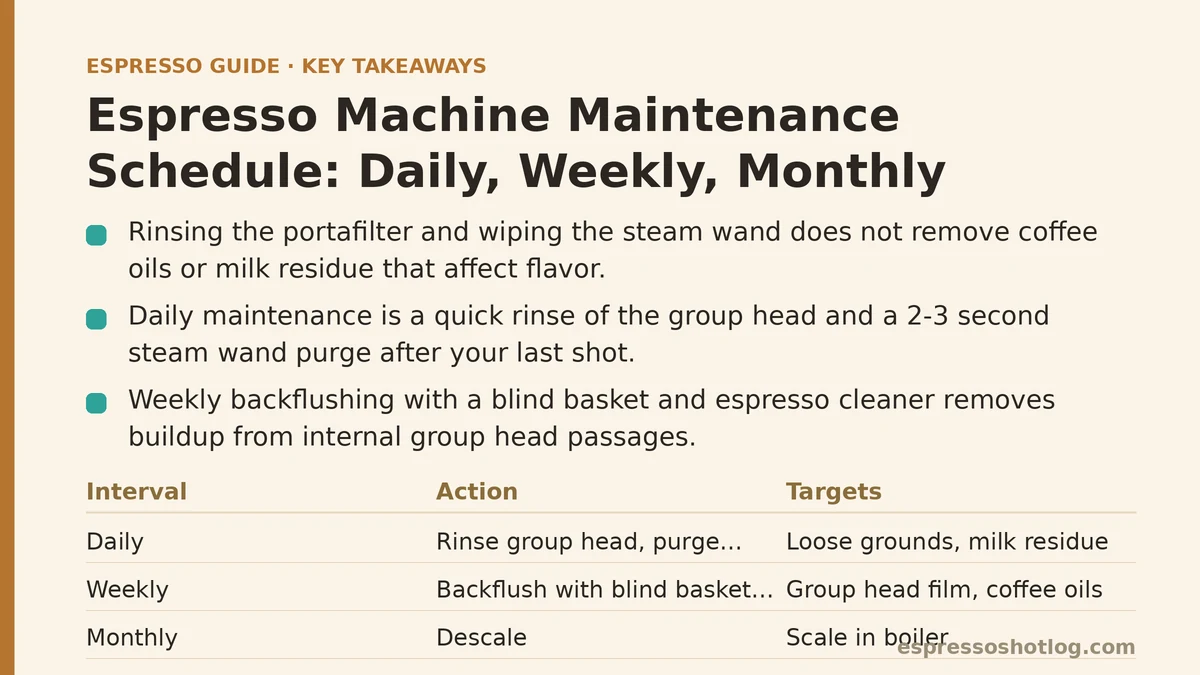
Most home espresso owners rinse the portafilter under hot water after pulling a shot, wipe the steam wand with a cloth, and call it done. That routine handles the visible mess. It does nothing for what is happening inside the machine.
Coffee oils and fine grounds accumulate in the group head’s dispersion screen and the portafilter basket, even when you cannot see them. They bake onto the metal under heat, turning into a dark, sticky residue that alters the flavor of every subsequent shot. Steam wand milk residue does the same on the inside of the tip — invisible, but it sours within hours at room temperature and taints the next pitcher of milk with a stale, cooked taste.
The myth is that rinsing removes these deposits. Water alone cannot break down coffee oil or dried milk protein. That requires detergent — either a dedicated espresso machine cleaner for the group head, or a quick steam wand purge and wipe for the milk path. The daily rinse is the start of a routine, not the routine itself.
The Reality: Three Cadences, Three Types of Buildup
Each maintenance interval exists because each type of residue forms on a different timescale. Coffee oil and loose grounds accumulate hour by hour. Milk residue and group head film harden over days. Scale — mineral deposits from hard water — builds inside the boiler over weeks and months, invisible until it restricts flow or causes the machine to overheat.
Daily: the rinse and purge. After your last shot of the day, run water through the group head for a few seconds with the portafilter removed. This flushes loose grounds that the shot itself did not carry away. Then purge the steam wand for two to three seconds into a towel or drip tray to clear any milk that climbed back up the tip. Wipe both surfaces dry. That is the daily minimum, and it takes under a minute.
Weekly: the backflush. This is the step most home users skip, and it is the one that keeps the group head tasting clean. Backflushing means blocking the flow of water through the group head with a blind basket — a portafilter basket with no holes — so water is forced back through the dispersion screen and internal passages, carrying detergent through the parts that never see direct rinsing.
To do it: insert the blind basket, add a small scoop of espresso machine cleaner — the powder is measured by the manufacturer, usually about half a gram — lock the basket into the group head, and run the brew cycle for ten seconds. Stop, wait ten seconds, repeat. Then remove the basket, run clean water through the group head for ten seconds to rinse, and repeat the entire cycle once more without detergent. The water that comes out will be cloudy and brown the first time if you have never backflushed. That cloudiness is the film that has been flavoring every shot you pulled for weeks.
Monthly: the deep check and descale (as needed). This is where you inspect what the weekly routine cannot reach. Remove the dispersion screen from the group head — most are held by a single screw — and soak it in a small bowl with espresso cleaner and hot water for fifteen minutes. Look at the shower screen’s holes. If they are clogged or darkened, the soak will loosen the residue, and an old toothbrush will finish the job.
The descale question depends on your water. If you use filtered or bottled water with low mineral content, a monthly descale is overkill. If your tap water is hard and you have not descaled in six months, your machine’s boiler may already be lined with scale that restricts water flow and makes the machine run hotter than its thermostat reads. The practical test: if your shots have started pulling slow even after grinding coarser, and your steam wand has lost pressure, scale is the likely culprit. Use a descaling solution formulated for espresso machines — not vinegar, which can damage seals and leave a lingering taste — and follow the manufacturer’s dilution ratio exactly. Many home machines need descaling every two to three months under hard water, not every month. Observe your machine rather than following a rigid calendar.
The Group Head Gasket: The Part People Forget
Between weekly backflushes and monthly screen soaks, one component quietly degrades: the group head gasket. This silicone or rubber ring creates the seal between the portafilter and the group head. It compresses every time you lock in the portafilter, and over months of use, it hardens or flattens.
The symptom is subtle at first. Your portafilter wiggles more than it used to when locked in, or you need to turn it further past the point where it used to stop. Then you notice water squirting sideways from the group head during a shot, or the espresso channeling — flowing faster through one side of the puck because the seal is uneven. That is the gasket talking.
Replacing it takes five minutes — unscrew the old ring from the group head, press the new one in — and the part costs a few dollars. Mark your calendar every six months to check the gasket’s flexibility. If it has gone rigid, replace it before it starts affecting your shots, not after.
The Steam Wand: The Daily Neglect That Compounds
The steam wand is the most abused part of any espresso machine, and the easiest to clean incorrectly. After every steaming session, you should purge the wand for two seconds into a towel — this clears milk residue from the internal tube — then wipe the exterior with a damp cloth. The purge matters more than the wipe, because milk that dries inside the wand hardens into a crust that no amount of exterior polishing will remove.
When milk crust does build up — you will notice the wand steaming slower, or steam that sputters with water droplets — remove the tip if it unscrews and soak it in hot water with a milk cleaner for twenty minutes. A thin pipe cleaner or a straightened paper clip can gently clear the hole. Never use a hard wire brush on the tip’s delicate holes; you will enlarge them and the steam will lose pressure.
The deeper problem: a wand with internal buildup turns your milk into a turbulent, frothy mess instead of smooth microfoam, and you will blame your technique when the equipment is the bottleneck. Clean the wand properly and suddenly your latte art improves overnight. That is not a coincidence.
The Myth: “Professional Cleaning Chemicals Are Unnecessary at Home”
There is a strain of home espresso wisdom that says detergent backflushes are for cafes, and that plain water backflushes are enough for a machine pulling two or three shots a day. This position has more confidence than evidence behind it.
In maintenance discussions with home users, the machines with scale inside the boiler and baked-on group head film are often the ones where the owner believed the “water-only” approach. Coffee oil does not dissolve in water, no matter how hot it is. The chemical cleaner exists because it targets the specific compounds in coffee oil that water cannot touch. A water backflush is a better rinse than no backflush, but it is not a replacement for detergent.
The same logic applies to descaling. Some owners push a “descaling-free” life using only filtered water, which works until it does not — a single month of hard tap water can deposit enough scale to slow a boiler, especially if the machine sat unused for a while and the scale settled. Buy a packet of espresso cleaning powder and a bottle of descaling solution. They cost less than one bag of specialty coffee, and they protect the machine that cost you a thousand times more.
The Reality: What the Schedule Looks Like in Practice
Here is the rhythm I recommend to home users, and the one that has kept my own machine pulling clean shots for years:
Daily (one minute): run water through the group head with the portafilter removed for five seconds. Purge the steam wand for two seconds. Wipe both with a dry cloth. Empty and rinse the drip tray.
Weekly (ten minutes): backflush with espresso cleaner using a blind basket. Rinse with a clean water cycle. Wipe the group head gasket area with a cloth.
Monthly (twenty minutes): remove the dispersion screen and soak it in cleaner. Wipe the inside of the group head with a cloth. Check the gasket for hardness or cracks. Inspect the steam wand tip for milk crust and soak if needed.
Every three to six months (one hour, as needed): descale per the manufacturer’s instructions if your water has minerals. Replace the group head gasket if it has hardened. Run a final backflush to clear any descaling solution residue.
The total time is under two hours a year. The payoff is shots that taste like your beans, not like the buildup that has been hiding in your group head. And when something does go wrong, you will know it sooner — because you will have a baseline for how your machine behaves when everything is clean.
Why This Schedule Wins Over “Clean When It Looks Dirty”
The look-clean approach fails for one reason: the most damaging buildup is invisible. You cannot see coffee oil film on the dispersion screen until you remove it and soak it — at which point the cloudy water tells you exactly what has been flavoring your shots. You cannot see scale inside the boiler until it restricts flow. By the time a problem is visible, it has already affected dozens of shots and possibly shortened the machine’s lifespan.
A set schedule removes the guesswork. You do not need to inspect the machine every time to decide if it needs cleaning. You clean on a rhythm, the machine stays consistent, and your shots taste the same week after week after week — which is the whole point of owning an espresso machine in the first place.
What has been the most confusing part of maintaining your machine — the backflush, the descale, or just knowing when something is overdue? Leave me your setup and your water type, and I can tell you which part of the schedule matters most for your specific situation.
Related guides: Espresso Machine Maintenance Mistakes That Ruin Your Shots and How to Avoid Them, Common Mistakes When Buying Your First Espresso Machine, and Espresso Machine Buying Guide for Beginners: Your First Setup.